5) The waiter got a five-pound
note from the gorilla.
6) There are usually many
gorillas in that place.
III.Choose the correct answer
1) The gorilla ordered__.
a)a cup of teab) a
cup of coffeec) a
glass of coffee
2) The gorilla sat looking
at__.
a)the waiterb) the
wallc)
the ceiling
3) The waiter went for some
change__.
a)to the kitchen b) to the barc) to the counter
4) The waiter gave the
gorilla__.
a)a pound note b) a pound coinc) a penny
5) The gorilla paid __for his
drink.
a)five poundsb) four poundsc) one pound
6) When the gorilla got the
change__.
a)he laughedb) he
smiledc) he
told a joke
The texts for teachers
I. The dialogue.
At the chemist’s shop.
P. Can Ihelp you?
W. Yes. Have you got anything for a headache?
P. Is it for an adult?
W. Yes. For my husband, actually.
P. I see. And how bad is it?
W. Well, quite bad, actually.
P. We've got aspirin or paracetamol.
W. Paracetamol, please.
P. A large or a small bottle?
W. How big are they?
P. 50 tablets or 100 tablets.
W. A small bottle then, please. And how many can he take?
P. He can take two every four hours. It's on the side of the bottle. But
if he's very bad, I think he
should see a doctor.
W. Fine. Do I pay here?
P. No. If you could take it to the cash desk over there, please...
II. Listen to the
text.
The Gorilla Joke
A gorilla went into a coffee shop,
sat down and ordered a cup of coffee. The waiter was a bit nervous at first,
but there weren't any other customers and the gorilla seemed quite friendly, so
he let him sit in peace. Who'd argue with a gorilla, anyway? While the waiter
made the coffee, he watched the gorilla from the kitchen. The gorilla just sat
there, staring at the ceiling. The kettle boiled and the waiter made a fresh
cup of coffee and took it in. The gorilla handed him a five-pound note, and
went on drinking coffee. The waiter took the five-pound note and went back to
the kitchen to get some change. While he was in the kitchen he watched the
gorilla, who drank the coffee, but for the rest of the time just stared at the
ceiling. The waiter thought to himself, 'That gorilla won't know the difference
between a pound note and a five-pound note — he's only a gorilla, after all.'
So he took a pound coin and went in to give it to the gorilla. As he handed it
over, he said: "We don't get many gorillas in here". The gorilla took
the pound and replied: "I'm not surprised, with coffee at four pounds a
cup"
Friday,the twelft of December.
Reading
London
London is
the capital of Great Britain. London is a very old town. London is two thousand
years old. Many years ago London was a small town on the Thames. There were a
lot of villages round it. After many years London and three hundred villages
grew into a very large city. Some of the names of those villages are the names
of the streets in modern London-Kensington, Westminster.
Now London is a beautiful city with large
squares and parks. The city of London is the business centre. East End includes
the poor districts. West of London is the West End where rich people live.
Trafalgar Square is in the centre of the
West End of London. In the centre of Trafalgar Square there is the column made
of granite. On the top of the column there is a 17-feet-tall statue of Admiral
Nelson who defeated the French at the Battle of Trafalgar in 1809. The total
high of the monument is 184 feet (44 meters).On the pedestal is a bronze relief
cast from a captured French cannon, representing Nelson’s victory. Trafalgar
Square is one of the busiest place in London, where people go to. On the North
side of Trafalgar Square is the National Gallery. The National Gallery has one
of the finest collections of pictures in the world.
1. Answer the questions
a.What
is the capital of Great Britain?
b.How
many years is London?
c.What
includes the poor districts?
d.Where
is the Admiral Nelson column?
2. Complete the sentences
a.On
the top of the column …
b.London
is two…
c.On
the north side…
d.The
total high…
e.There
were…
f.West
of London….
3. Find in the text
a.Національна
галерея має одну з найпрекрасніших колекцій світу.
b.Трафальгарска
площа знаходится в центрі Вест Енду в Лондоні.
c.Зараз
Лондон –одне з найкрасивіших міст з великими площами та сквераии.
d.Через
багато років Лондон і три сотні сіл перетворилися на одне велике місто.
e.Деякі
з цих сіл стали назвами в сучасному Лондоні.
Tuesday,the sixteenth of December.
Writing
I. Complete
the sentences with „How many …?” or „How much …?”
1.________lemonade can we take?
2.________tomatoes do you need for salad?
3._______ salt do you put in your
soup?
4.________cans of Coke did you buy yesterday?
5. _______ butter have you made?
6. _______ candies are there in the box?
II Complete
the sentences with must/should.
1. You ____take part in a sport regularly.
2. You ______ n’t drink cold water. You can get a sore throat.
3 _______ you sleep eight hours a day?
4. Sue needs to lose some weight. I believe she _____ exercise more.
5. You ____n’t smoke.
6. When ___you consult a doctor?
7. We ____ wash our hands before
meals.
8. You ____ be more careful to your health.
III. Complete the sentences with the correct question tags.
1. Alexander Fleming discovered penicillin 200
years ago,…..?
2. I am interested in the history of the
traditional British food, …..?
3. Bob hasn’t watered the lawn yet, …..?
4 .My sister is wearing an embroidered blouse,
…..?
5. He can’t swim very well, ……?
6. Steve started to feel ill last Monday,……?
7.
Let’s go to the cinema, …..?
8. They are working in the garden now, …..?
9. Clark doesn’t often assist the father in
repairing a car, …..?
10. You will help me, …..?
Thursday,the eighteenth the December.
Speaking
School
Life (Шкільне життя)
1.What subjects do you study at school?
2.Who is your favorite teacher and why?
3.What activities do you enjoy during recess?
4.How do you prepare for exams?
5.Describe a typical school day for you.
Household
Chores (Домашні обов'язки)
1.What chores are you responsible for at home?
2.How do you balance schoolwork and household chores?
3.Which household chore do you like the most and why?
4.Do you think it is important for everyone to help with
chores? Why?
5.How does your family divide household chores?
Food
and Cooking (Їжа та кулінарія)
1.What is your favorite dish to cook?
2.Describe a traditional dish from your country.
3.What ingredients do you need to make your favorite meal?
4.Do you prefer cooking at home or eating out? Why?
5.How often do you try new recipes?
Tradition
and Holidays (Традиції та свята)
1.What is your favorite holiday and how do you celebrate it?
2.Describe a traditional holiday in your country.
3.How do you prepare for celebrations?
4.What family traditions do you have for holidays?
5.Why do you think traditions are important?
Tuesday,the sixteenth of December.(16.12) Reading
London
London is the capital of Great
Britain. London is a very old town. London is two thousand years old. Many
years ago London was a small town on the Thames. There were a lot of villages
round it. After many years London and three hundred villages grew into a very
large city. Some of the names of those villages are the names of the streets in
modern London-Kensington, Westminster.
Now London is a beautiful city with large
squares and parks. The city of London is the business centre. East End includes
the poor districts. West of London is the West End where rich people live.
Trafalgar Square is in the centre of the
West End of London. In the centre of Trafalgar Square there is the column made
of granite. On the top of the column there is a 17-feet-tall statue of Admiral
Nelson who defeated the French at the Battle of Trafalgar in 1809. The total
high of the monument is 184 feet (44 meters).On the pedestal is a bronze relief
cast from a captured French cannon, representing Nelson’s victory. Trafalgar
Square is one of the busiest place in London, where people go to. On the North
side of Trafalgar Square is the National Gallery. The National Gallery has one
of the finest collections of pictures in the world.
1. Answer the
questions
What is the capital of Great
Britain?
How many years is London?
What includes the poor
districts?
Where is the Admiral Nelson
column?
2. Complete the
sentences
On the top of the column …
London
is two…
On
the north side…
The
total high…
There
were…
West
of London….
3. Find in the
text
Національна
галерея має одну з найпрекрасніших колекцій світу.
Трафальгарска
площа знаходится в центрі Вест Енду в Лондоні.
Зараз
Лондон –одне з найкрасивіших міст з великими площами та сквераии.
Через
багато років Лондон і три сотні сіл перетворилися на одне велике місто.
Деякі
з цих сіл стали назвами в сучасному Лондоні.
Thursday,the eighteenth(nineteenth) of December.(18.12-19.12).
Writing
I. Complete
the sentences with „How many …?” or „How much …?”
1.________lemonade can we take?
2.________tomatoes do you need for salad?
3._______ salt do you put in your
soup?
4.________cans of Coke did you buy yesterday?
5. _______ butter have you made?
6. _______ candies are there in the box?
II Complete
the sentences with must/should.
1. You ____take part in a sport regularly.
2. You ______ n’t drink cold water. You can get a sore throat.
3 _______ you sleep eight hours a day?
4. Sue needs to lose some weight. I believe she _____ exercise more.
5. You ____n’t smoke.
6. When ___you consult a doctor?
7. We ____ wash our hands before
meals.
8. You ____ be more careful to your health.
III. Complete the sentences with the correct question tags.
1. Alexander Fleming discovered penicillin 200
years ago,…..?
2. I am interested in the history of the
traditional British food, …..?
3. Bob hasn’t watered the lawn yet, …..?
4 .My sister is wearing an embroidered blouse,
…..?
5. He can’t swim very well, ……?
6. Steve started to feel ill last Monday,……?
7.
Let’s go to the cinema, …..?
8. They are working in the garden now, …..?
9. Clark doesn’t often assist the father in
repairing a car, …..?
10. You will help me, …..?
Tuesday,the thirteenth of January.(13.01)
Class work
1.New words.
baseman -гравець(бейсболу)
championship-чемпіон
contract-контракт
match-мач
shortstop-позиція в бейсболі
Uruguay-Уругвай
bronze-бронза
to defeat-перемагати
to keep up with smth-не відставати від чогось
to turn out-виявляться
2.Do 1-3,p.80-81.
3.Homework-ex.4,p.81,learn the new words.
Thursday,the fifteenth of January.(15.01)
Class work
1.New words.
athletics-легкоатлетика
weightlifting-важка атлетика
cycle ball-волебол
windsurfing-віндсерфінг
wrestling-боротьба
zorbing-зорбін
elephant polo-поло на слонах
underwater hockey-підводний хокей
2.Do 1-2,p.83.
3.Homework-ex.3,p.83,learn the new words.
Friday,the sixteenth of January.(16.01)
Class work
1.New words.
disability-інвалідність
discipline-дисципліна(на спорт.Олімпіаді)
motto -девіз
rowing-веслування
parallel-паралельний
to appear-з'являться
to compete-змагатися
to represent-представляти
to be held-проводитися (про змагання)
2.Do 1-3,p.84-85.
3.Homework-ex.4,p.85,learn the new words.
Tuesday,the twentieth of January.
Class work
1.Grammar.
Затвердження
Пасивний стан у минулому використовується, коли нам більш важлива особа або предмет, над яким сталася дія, а не той, хто її вчинив.
. ⇒Щоб скласти стверджувальне речення в Passive Voice - Past Simple, необхідно:
1. поставити на перше місцеI/we/you/they/he/she/it або іменник в однині або у множині; 2. was/were; 3. До дієслова додати закінчення-edабо використовувати його 3-ю форму (для неправильних дієслів); 4. решта слів.
⇒Зверніть увагу на форми to be в минулому пасивному стані.
-I/He/she/itабо іменник в однині вживаються зwas; -We/you/theyабо іменник(-и) у множині вживаються зwere.
Заперечення
Негативні речення в Passive Voice - Past Simple утворюються за допомогою was/were і not. Вони часто скорочуються до wasn't та weren't. Давайте розглянемо їхнє вживання.
1. На перше місце поставте I/we/you/they/he/she/it або іменник в однині або у множині; . 2. was/were not або скорочену форму wasn't/weren't; 3. Дієслово із закінченням -ed або використовуйте його 3-ю форму (для неправильних дієслів); . 4. решта слів.
⇒ У заперечних реченнях до форми дієслова to be додають частку not.
. - I/He/she/it was not або wasn't; - We/you/they were not або weren't.
Питання
Запитальні речення в Passive Voice - Past Simple утворюються за допомогою Was/Were. Розглянемо їхнє утворення
. - Was вживається з I/he/she/it та дієсловом з - ed а
бо використовується його 3-тя форма (для неправильних дієслів). - Were вживається з you/we/they і дієсловом з - ed або використовується його 3-тя форма (для неправильних дієслів).
⇒ Якщо в запитанні є слова What?, Where?, When? тощо, то was/were стоять після них.
2.Do 1-2,p.86.
3.Homework-ex.3,p.86.
Thursday,the twenty-second of January.
Class work
1.Do ex.1-2,p.87.
2.Homework-ex.3.p.87.
Friday,the twenty-third of January.
Class work
1.New words.
pitch – поле (для футболу, регбі тощо)
puck – шайба (для хокею)
stick – ключка / клюшка (для хокею)
rink – ковзанка
court – корт (для тенісу, баскетболу, волейболу)
net – сітка
basket – кошик (для баскетболу)
2.Do ex.1-2,p/88-89.
3.Homework-ex.3,p.89,learn the new words.
Tuesday,the twenty-seventh of January.
Class work
1.
Спеціальні питання (Wh-questions) у Past Simple Passive (пасивний стан) утворюються за формулою:
Wh-word + was / were + підмет + V³ / -ed?
У таких реченнях увага зосереджується на об’єкті дії (наприклад, що було зроблено), а не на тому, хто виконав дію.
Використовується was (для однини / I) та were (для множини / you, we, they).
Структура та прикладиФормула:
Wh-word (What, Where, When…) + was / were + Subject + V³ (Past Participle)?
Приклад 1: When was the letter sent?
— Коли лист було надіслано?
Приклад 2: Where were the keys found?
— Де були знайдені ключі?
Приклад 3: Why was the window broken?
— Чому вікно було розбите?
Основні правила
Порядок слів:
Питальне слово (Who, What, Where, When, Why, How) ставиться на початку речення, перед was / were.
Дієслово to be:
Форма was / were залежить від підмета, а не від виконавця дії.
Смислове дієслово:
Завжди використовується у третій формі (V³ — Past Participle).
Виконавець дії:
Якщо він зазначається, то додається в кінці речення з прийменником by
(наприклад: …by them).
2.Do ex.1-3,p.90.
3.Homework-ex.1,p.91.
Thursday,the twenty-ninth of January.
Class work
1.Do ex 2,p.92,ex 1,p.93.
2.Homework-ex.2,p.93.
Friday,the thirtieth of January.
Class work
1.Do ex.1-4,p.94-95.
2.Homework-ex.6,p.95.
Tuesday,the third of February.
Class work
1.Do ex 7-8,p.97.
3.Homework-ex.9,p.97.
Thursday,the fifth of February.
Class work
1.Do ex 1-3,p.98.
2.Preparation for the test.
Unit 5. Sport from A to Z Variant I
I. Make sentences, use Past Simple Passive.
breakfast / make / by mum – Breakfast was made by mum.
III. Fill in the sentences with the words from the box.
a wheelchair tennis, across the world, a flame,
training session, competitions
1.There are a lot of ……….. in winter Olympics games.
2. Thousands of athletes compete in cycling, ………..,
swimming and many other events.
3.The………..travels though many countries.
4. A torch is
lit at Olympia in Greece and sportsmen carry……….. .
5. This tennis player has got a ………… .
IV. Put the questions to the answers below.
Yes, it was. The game was
invented yesterday.
Tennis and baseball. These kinds of sport were chosen.
In London.
Lia Levis was born there.
No, they weren’t. The
Olympic games weren’t held in May.
No, they weren’t. They weren’t prepared to play.
V. Circle the correct word.
1. They play basketball on the school (rink/court).
2. The athlete was given a (bronze/wooden) medal.
3. You need to be strong to do (weightlifting/tennis).
4. The seats are (rowing/parallel) to the football
field.
Tuesday,the tenth of February.
Class work
1.New words.
aid — допомога
accident — нещасний випадок, аварія
ambulance — швидка допомога
breath — подих, дихання
death — смерть
emergency — надзвичайна ситуація
wound — рана
to bleed — кровоточити
to breathe — дихати
to react — реагувати
to save — рятувати, зберігати
backwards — назад, у зворотному напрямку
immediately — негайно, одразу
to get stuck — застрягти
to pay attention — звертати увагу
2.Do ex 1-5.p.100-101.
3.Learn the new words,ex.6,p.102.
Thursday,the twelfth of February.
Class work
1.New words.
disease — хвороба
illness — захворювання, недуга
pill — пігулка, таблетка
surgeon — хірург
symptom — симптом
treatment — лікування
private — приватний
regular — регулярний, звичайний
regularly — регулярно
to make an appointment — записатися на прийом (до лікаря)
1.Do ex 1,p.103,ex.1,p.104.
2.Ex.2,p.105,learn the new words.
Friday,the thirteenth of February.
Class work
1.Do ex 3-4,p.105.
2.Ex.5,p.105.
Tuesday,the seventeenth of February.
Class work
1.Zero Conditional(нульовий тип умовних речень) використовується для опису загальних фактів, наукових істин, законів природи, правил та звичок, які завжди правдиві. Конструкція будується з двох частин:If + Present Simple(умова) +Present Simple(результат), де дія завжди призводить до однакового результату.
Основні характеристики Zero Conditional:
Функція: Опис речей, які є істинними за будь-яких обставин (наприклад, "Якщо нагріти лід, він тане").
Час: Теперішній час (Present Simple) в обох частинах речення.
Структура:
If + Subject + V1 (s/es), Subject + V1 (s/es).
Приклад: If you freeze water, it becomes a solid. (Якщо заморозити воду, вона стає твердою.).
Заміна if: Замість if можна використовувати when, оскільки дія гарантована.
Приклади:
If it rains, the grass gets wet. — Якщо йде дощ, трава стає мокрою.
If you mix red and yellow, you get orange. — Якщо змішати червоний і жовтий, отримаєш помаранчевий.
I can't sleep if I drink coffee at night. — Я не можу спати, якщо п'ю каву вночі.
Важливі нюанси:
Кома ставиться, якщо речення починається з "If".
Цей тип не стосується майбутнього, а лише загальних істин.
2.Do ex 1-4,p.106-107.
3.Ex.5,p.107.
Thursday,the nineteenth of February.
Class work
1.Do ex 1-2,p.108.
2.Ex.3,p.108.
Friday,the twentieth of February.
Class work
1.Do ex 1-2,p.109.
2.Ex.3,p.109.
Speaking
бути схвильованим, радісно збудженим 2.Do ex.1,p.67,ex.1,p.68,ex.1,p.69. 3.Homework-ex.9,p.71, to prepare for the test.
Tuesday,the ninth of December. Test
Test 5 grade Name __________________________________
1.I am so _______________! It’s my birthday tomorrow.
2.It’s Halloween! Let’s go ____________________!
3.Ah! You look so _______________ in this costume!
4. We always have a _________________ dinner on Christmas Day.
5. There are many ________________ like Easter and Christmas.
6. Christmas is a very __________________ holiday in the world.
2.Past Simple
1.Tom __________(help) her mother yesterday.
2.There _________ (be) many fireworks on Independence Day last year.
3.John __________ (play) computer games yesterday.
4.We ____________ (go) to the parade last Sunday.
5.Sam ____________ (make) a big cake for my birthday.
3.M1.Tell about your age and family
2.Tell about your favorite school subject
3.Tell about your hobbies
4.Tell about the parties your friends likes most of allatch holidays with the dates
1. Independence DayA) October, 31
2. St. Nicholas DayB) April or May
3. St Valentine’s DayC) December, 25
4. EasterD) August, 24
5. ChristmasE) March, 8
6. New YearF) February, 14
7. HalloweenG) January,1
8. Women’s DayH) December, 6
Thursday,the eleventh of December. Listening
Jim and Betty
Hello. My name is Jim. I live in Eastbourne. I am nine. I like reading and playing football. I have got very nice toys. My favourite toysare a spaceship and a kite. I keep them in the cupboard. I also like watching videos. After school I like playing computer games.
This is my sister, Betty. She is seven. Betty likes computer games and listening to music, too. She likes playing with her dolls. She has got two dolls. She calls them Milly and Lilly. She also has got two toy rabbits. She keeps the dolls and the rabbits on her bed.
Test:
1)What is the boy’s name?a) Dan;b) Jim; c) Ben;
2)How old is Jim?a) Nine;b) Ten; c) Eleven;
3)Where does he live?a) London; b) Oxford; c) Eastbourne;
4)What does he like?a) Reading and playing football;
b) Riding a bike and swimming;
c) Drawing and playing tennis;
5)What are his favourite toys?a) A computer and a toy truck;
b) A spaceship and a kite;
c) A robot and a plane;
6)Where does Jim keep his toys?a) On the shelf;b) Under the desk; c) In the cupboard;
7)What is his sister’s name?a) Vicky,b) Bettty; c) Kate;
8) How old is Betty?a) Eight; b) Nine; c) Seven;
9) What does Betty like?a) Computer games and listening to music;
b) Reading and drawing;
c) Helping at home and singing;
10) How many dolls does she have?a) Three; b) Two; c) Four;
11)What else does she have got?a) Balls; b) Puzzles; c) Rabbits;
12) Where does Betty keep her toys?a) In the cupboard; b) On her bed; c) In the toy box;
Friday,the twelfth of December. Reading
Jane's working day
Jane is a schoolgirl. She is 9 years old. She goes to school № 5. She has got five or six lessons every day. Her favourite subject is English. She likes to read, write and speak English. In the lessons of Maths she counts and does sums. Jane is good at Maths. Pupils have short breaks between the lessons. They can run on the playground, jump and play games. School is over at 2 o'clock in the afternoon. Jane goes home. She puts away her schoolbag, washes her hands and has dinner. For dinner she usually has some soup, meat or fish with potatoes and a glass of juice. When she finishes her dinner she washes the dishes. Then she can have a rest. She is crazy about listening to music and watching cartoons.
I level. Fill in the gaps with the appropriate word from the box.
is over, is good at, short breaks, speaks English, play games, watching cartoons
1. My working day (to begin) at six o'clock. 2. I (to get) up, (to switch) on the TV and (to brush) my teeth. 3. It (to take) me about twenty minutes. 4. I (to have) breakfast at seven o’clock. 5. I (to leave) home at half past seven. 6. I (to take) a bus to the institute. 7. Classes (to begin) at eight.
2.Fillinthegapswiththewordsfromthebox.
some, are, is, any, are, any
1)There _____ 10 eggs and a bottle of milk in the fridge.
2)Is there____ sugarin the coffee?
3)I like _____ fruit and a sandwich for lunch.
4)There _____ a lot of vitamins in juice.
5)There_____ no bread left.
6)We don’t have ____ sour cream for pancakes.
3.Complete the sentences with Present Continuous Tense:
1.Listen to the football fans. They (sing)songs.
2.Look at him. He (try)to help her.
3. The other one (help)his father with car.
4. They feel happy because they (have)a good time here in this park.
Thursday,the eighteenth of December.
Speaking
1.Tell about your age and family
2.Tell about your favorite school subject
3.Tell about your hobbies
4.Tell about the parties your friends likes most of all
Tuesday,the sixteenth of December.(16.12)
Reading
READING СOMPREHENSION
Jane's working day
Jane is a schoolgirl. She is 9 years old. She goes to school № 5. She has got five or six lessons every day. Her favourite subject is English. She likes to read, write and speak English. In the lessons of Maths she counts and does sums. Jane is good at Maths. Pupils have short breaks between the lessons. They can run on the playground, jump and play games. School is over at 2 o'clock in the afternoon. Jane goes home. She puts away her schoolbag, washes her hands and has dinner. For dinner she usually has some soup, meat or fish with potatoes and a glass of juice. When she finishes her dinner she washes the dishes. Then she can have a rest. She is crazy about listening to music and watching cartoons.
I level. Fill in the gaps with the appropriate word from the box. is over, is good at, short breaks, speaks English, play games, watching cartoons
1. Jane … Maths.
2. Children like to … on the playground.
3. Pupils have … between the lessons.
4. When school … Jane comes home.
5. She … at the lessons.
6. She is crazy about …
II level. Say if it is true or false.
Jane is eight years old.
She is crazy about listening to music.
She has seven lessons every day.
She doesn’t like to read.
In Maths she counts and does sums.
She washes the dishes.
III level. Answer the following questions.
1. Is Jane a schoolgirl?
2. How old is she?
3. How many lessons has she got every day?
4. What's her favourite subject?
5. Is she good at Maths?
6. When is school over?
Thursday the eighteenth(nineteenth) of December.(18.12-19.12)
1. My working day (to begin) at six o'clock. 2. I (to get) up, (to switch) on the TV and (to brush) my teeth. 3. It (to take) me about twenty minutes. 4. I (to have) breakfast at seven o’clock. 5. I (to leave) home at half past seven. 6. I (to take) a bus to the institute. 7. Classes (to begin) at eight.
2.Fillinthegapswiththewordsfromthebox.
some, are, is, any, are, any
There _____ 10 eggs and a bottle of milk in the fridge.
Is there____ sugar in the coffee?
I like _____ fruit and a sandwich for lunch.
There _____ a lot of vitamins in juice.
There_____ no bread left.
We don’t have ____ sour cream for pancakes.
3.Complete the sentences with Present Continuous Tense:
1.Listen to the football fans. They (sing)songs.
2.Look at him. He (try)to help her.
3. The other one (help)his father with car.
4. They feel happy because they (have)a good time here in this park.
Tuesday,the thirteenth of January.(13.01)
Class work
1.New words.
climate [klaimt]-клімаи
rainforest [reinfArist]-дощовий ліс
chilly [t1ilI]-прохолодний
foggy [fAgI]-туманний
freezing [frI:xiN]-крижаний
however [haUevе]-однак,проте
2.Do 1-3,p.74-75.
3.Homework-ex.5,p.75,learn the new words.
бути схвильованим, радісно збудженим 2.Do ex.1,p.67,ex.1,p.68,ex.1,p.69. 3.Homework-ex.9,p.71, to prepare for the test.
Tuesday,the ninth of December. Test
Test 5 grade Name __________________________________
1.I am so _______________! It’s my birthday tomorrow.
2.It’s Halloween! Let’s go ____________________!
3.Ah! You look so _______________ in this costume!
4. We always have a _________________ dinner on Christmas Day.
5. There are many ________________ like Easter and Christmas.
6. Christmas is a very __________________ holiday in the world.
2.Past Simple
1.Tom __________(help) her mother yesterday.
2.There _________ (be) many fireworks on Independence Day last year.
3.John __________ (play) computer games yesterday.
4.We ____________ (go) to the parade last Sunday.
5.Sam ____________ (make) a big cake for my birthday.
3.M1.Tell about your age and family
2.Tell about your favorite school subject
3.Tell about your hobbies
4.Tell about the parties your friends likes most of allatch holidays with the dates
1. Independence DayA) October, 31
2. St. Nicholas DayB) April or May
3. St Valentine’s DayC) December, 25
4. EasterD) August, 24
5. ChristmasE) March, 8
6. New YearF) February, 14
7. HalloweenG) January,1
8. Women’s DayH) December, 6
Thursday,the eleventh of December. Listening
Jim and Betty
Hello. My name is Jim. I live in Eastbourne. I am nine. I like reading and playing football. I have got very nice toys. My favourite toysare a spaceship and a kite. I keep them in the cupboard. I also like watching videos. After school I like playing computer games.
This is my sister, Betty. She is seven. Betty likes computer games and listening to music, too. She likes playing with her dolls. She has got two dolls. She calls them Milly and Lilly. She also has got two toy rabbits. She keeps the dolls and the rabbits on her bed.
Test:
1)What is the boy’s name?a) Dan;b) Jim; c) Ben;
2)How old is Jim?a) Nine;b) Ten; c) Eleven;
3)Where does he live?a) London; b) Oxford; c) Eastbourne;
4)What does he like?a) Reading and playing football;
b) Riding a bike and swimming;
c) Drawing and playing tennis;
5)What are his favourite toys?a) A computer and a toy truck;
b) A spaceship and a kite;
c) A robot and a plane;
6)Where does Jim keep his toys?a) On the shelf;b) Under the desk; c) In the cupboard;
7)What is his sister’s name?a) Vicky,b) Bettty; c) Kate;
8) How old is Betty?a) Eight; b) Nine; c) Seven;
9) What does Betty like?a) Computer games and listening to music;
b) Reading and drawing;
c) Helping at home and singing;
10) How many dolls does she have?a) Three; b) Two; c) Four;
11)What else does she have got?a) Balls; b) Puzzles; c) Rabbits;
12) Where does Betty keep her toys?a) In the cupboard; b) On her bed; c) In the toy box;
Friday,the twelfth of December. Reading
Jane's working day
Jane is a schoolgirl. She is 9 years old. She goes to school № 5. She has got five or six lessons every day. Her favourite subject is English. She likes to read, write and speak English. In the lessons of Maths she counts and does sums. Jane is good at Maths. Pupils have short breaks between the lessons. They can run on the playground, jump and play games. School is over at 2 o'clock in the afternoon. Jane goes home. She puts away her schoolbag, washes her hands and has dinner. For dinner she usually has some soup, meat or fish with potatoes and a glass of juice. When she finishes her dinner she washes the dishes. Then she can have a rest. She is crazy about listening to music and watching cartoons.
I level. Fill in the gaps with the appropriate word from the box.
is over, is good at, short breaks, speaks English, play games, watching cartoons
1. My working day (to begin) at six o'clock. 2. I (to get) up, (to switch) on the TV and (to brush) my teeth. 3. It (to take) me about twenty minutes. 4. I (to have) breakfast at seven o’clock. 5. I (to leave) home at half past seven. 6. I (to take) a bus to the institute. 7. Classes (to begin) at eight.
2.Fillinthegapswiththewordsfromthebox.
some, are, is, any, are, any
1)There _____ 10 eggs and a bottle of milk in the fridge.
2)Is there____ sugarin the coffee?
3)I like _____ fruit and a sandwich for lunch.
4)There _____ a lot of vitamins in juice.
5)There_____ no bread left.
6)We don’t have ____ sour cream for pancakes.
3.Complete the sentences with Present Continuous Tense:
1.Listen to the football fans. They (sing)songs.
2.Look at him. He (try)to help her.
3. The other one (help)his father with car.
4. They feel happy because they (have)a good time here in this park.
Thursday,the eighteenth of December.
Speaking
1.Tell about your age and family
2.Tell about your favorite school subject
3.Tell about your hobbies
4.Tell about the parties your friends likes most of all
Tuesday,the sixteenth of December.(16.12)
Reading
READING СOMPREHENSION
Jane's working day
Jane is a schoolgirl. She is 9 years old. She goes to school № 5. She has got five or six lessons every day. Her favourite subject is English. She likes to read, write and speak English. In the lessons of Maths she counts and does sums. Jane is good at Maths. Pupils have short breaks between the lessons. They can run on the playground, jump and play games. School is over at 2 o'clock in the afternoon. Jane goes home. She puts away her schoolbag, washes her hands and has dinner. For dinner she usually has some soup, meat or fish with potatoes and a glass of juice. When she finishes her dinner she washes the dishes. Then she can have a rest. She is crazy about listening to music and watching cartoons.
I level. Fill in the gaps with the appropriate word from the box. is over, is good at, short breaks, speaks English, play games, watching cartoons
1. Jane … Maths.
2. Children like to … on the playground.
3. Pupils have … between the lessons.
4. When school … Jane comes home.
5. She … at the lessons.
6. She is crazy about …
II level. Say if it is true or false.
Jane is eight years old.
She is crazy about listening to music.
She has seven lessons every day.
She doesn’t like to read.
In Maths she counts and does sums.
She washes the dishes.
III level. Answer the following questions.
1. Is Jane a schoolgirl?
2. How old is she?
3. How many lessons has she got every day?
4. What's her favourite subject?
5. Is she good at Maths?
6. When is school over?
Thursday the eighteenth(nineteenth) of December.(18.12-19.12)
1. My working day (to begin) at six o'clock. 2. I (to get) up, (to switch) on the TV and (to brush) my teeth. 3. It (to take) me about twenty minutes. 4. I (to have) breakfast at seven o’clock. 5. I (to leave) home at half past seven. 6. I (to take) a bus to the institute. 7. Classes (to begin) at eight.
2.Fillinthegapswiththewordsfromthebox.
some, are, is, any, are, any
There _____ 10 eggs and a bottle of milk in the fridge.
Is there____ sugar in the coffee?
I like _____ fruit and a sandwich for lunch.
There _____ a lot of vitamins in juice.
There_____ no bread left.
We don’t have ____ sour cream for pancakes.
3.Complete the sentences with Present Continuous Tense:
1.Listen to the football fans. They (sing)songs.
2.Look at him. He (try)to help her.
3. The other one (help)his father with car.
4. They feel happy because they (have)a good time here in this park.
Tuesday,the thirteenth of January.(13.01)
Class work
1.New words.
climate [klaimt]-клімаи
rainforest [reinfArist]-дощовий ліс
chilly [t1ilI]-прохолодний
foggy [fAgI]-туманний
freezing [frI:xiN]-крижаний
however [haUevе]-однак,проте
2.Do 1-3,p.74-75.
3.Homework-ex.5,p.75,learn the new words.
Thursday,the fifteenth of January.(15.01)
Class work
1.New words.
cloudy [klaUdI-хмарний
stormy [stc:mI]-штормовий,буревій
wet [wet]-мокрий
2.Do 1-3,p.76.
3.Homework-ex.4,p.76,learn the new words.
Friday,the sixteenth of January.(16.01)
Class work
1.New words.
centigrade [sentigreid]-градус Цельсія
degree [digrI:]-градус
forecast [fc:k:st]-прогноз(погоди)
to expect [ikspekt]-очікувати
to report [ripc:t]-повідомляти
2.Do 1-2,p.77.
3.Homework-ex.4,p.78,learn the new words.
Tuesday,the twentieth of January.
Class work
1.Grammar.
Конструкція be going to в англійській мові використовується для вираження намірів, планів на майбутнє або для прогнозування подій на основі очевидних ознак (темні хмари, отже, буде дощ), перекладається як "збиратися", "планувати". Вона складається з дієслова to be (am, is, are, was, were), що змінюється за особою та часом, та незмінюваної частини going to + інфінітив основного дієслова.
Основні випадки вживання:
Плани та наміри: Коли дія вже вирішена або заздалегідь спланована.
I'm going to visit my grandparents this weekend. (Я збираюся відвідати своїх бабусь і дідусів цими вихідними).
Прогнози з доказом: Коли є явні ознаки того, що щось станеться.
Look at the clouds! It's going to rain. (Подивись на хмари! Зараз піде дощ).
Накази/Суворі розпорядження (менш поширене, але можливе):
You are going to finish your homework now! (Ти зараз же закінчиш своє домашнє завдання!).
Формула:
Subject + (am/is/are/was/were) + going to + Verb (infinitive).
Приклади:
Утвердження:She is going to study medicine. (Вона збирається вивчати медицину).
Заперечення:They are not going to come. (Вони не збираються приходити).
Питання:Are you going to watch the movie? (Ти збираєшся дивитися фільм?).
Утворення Future Simple
Future Simple — можливо, найпростіший час в англійській мові. Він утворюється навіть простіше, ніж Present Simple. Адже там допоміжне дієслово змінюється залежно від особи (перша, друга чи третя). А тут все просто.
Щоб утворити Простий майбутній час, потрібно поставити допоміжне дієслово «will» перед інфінітивом (першою формою) основного смислового дієслова (без частки «to»).
Стверджувальне речення будується за схемою «підмет + will + смислове дієслово».
2.Do 1-3,p.79.
3.Homework-ex.4,p.79,learn the new grammar.
Thursday,the twenty-stcond of January.
Class work
1.New words.
tie – краватка
shirt – сорочка
suit – костюм
jersey – джемпер / светр
bathrobe – халат
top – топ / жіноча майка
shorts – шорти
trainers – кросівки
leggings – легінси
underwear – білизна
flip-flops – шльопанці
slippers – тапочки
2.Do 1-3,p.80.
3.Homework-ex.4,p.80,learn the new words.
Friday,the twenty-third of January.
Class work
1.Do 1-2,p.81.
3.Homework-ex.3,p.81.
Tuesday,the twenty-seventh of January.
Class work
1.Zero Conditional (нульовий тип умовних речень) використовується для опису загальновідомих фактів, наукових істин, правил або звичок, які завжди справджуються. Його формула: If + Present Simple, Present Simple. Речення описує ситуацію, де дія
завжди призводить до результату
.
Основні характеристики:
Функція: Виражає 100% реальність, а не гіпотезу.
Час: Обидві частини речення вживаються у Present Simple.
Сполучники:If (якщо) можна замінити на when (коли), що часто підкреслює регулярність.
Структура:
If + Condition (умова), + Result (результат). -> If you freeze water, it becomes ice.
Result + if/when + Condition. -> Water becomes ice if you freeze it.
Приклади:
Scientific facts:If you mix blue and yellow, you get green.
Rules/Truths:If you don't water plants, they die.
Habits:If I don't set the alarm clock, I always oversleep.
Важливо: Zero Conditional відрізняється від First Conditional тим, що стосується загальних правил, а не можливості події в майбутньому.
2.Do ex.1-2 p.82.
3.Homework-ex.3 p.82,learn the new rule.
Thursday,the twenty-ninth of January.
Class work
1.New words.
careful — обережний / обережно 👉 ке́ефул
slippery — слизький 👉 слі́пері
2.Do ex.1-2 p.83.
3.Homework-ex.3 p.83,learn the new rule.
Friday,the thirtieth of January.
Clas work
2.Do ex.1-2 p.84.
3.Homework-ex.2 b p.84.
Tuesday,the third of February.
Class work
1.Do ex 1-4,p.85.
3.Homework-ex.5,p.86.
Thursday,the fifth of February.
Class work
1.Do ex 1-3,p.88.
2.Preparation for the test.
What’s the weather like today?”
Task 1
Підберіть пропущені слова.
cool cloudy sunny freezing raining foggy
1 It can get really … here in winter -25°C below zero. 2 I’ll put on my jumper because it’s ... 3 Oh, it’s so … today! Let’s go for a walk! 4 It’s … outside! Take an umbrella with you. 5 Tom can’t see anything because there is … 6 I don’t like it when the sky is …
Task 2
Закінчіть речення.
1
If it is sunny and hot
a
I wear my raincoat and waterproof boots.
2
If it is snowy and frosty
b
I wear my warm jumper, jeans and favourite trainers.
3
If it is rainy and cool
c
I wear swimsuit
4
If it is cloudy and cold
d
I wear my cap, a T-shirt, shorts and sandals.
5
If I go to the river or to the seaside
e
I wear my beautiful pink dress and red shoes.
6
If I go to the birthday party
f
I wear my pyjamas.
7
If I go to sleep
g
I wear a warm coat, a scarf and my boots.
Task 3
Оберіть правильний варіант відповіді
3.Homework-ex.4,p.88,preparation for the test.
.
Friday,the sixth of February.
Test
“What’s the weather like today?”
Task 1
Підберіть пропущені слова.
coolcloudysunnyfreezingrainingfoggy
1 It can get really … here in winter-25°C below zero. 2 I’ll put on my jumper because it’s ... 3 Oh, it’s so … today! Let’s go for a walk! 4 It’s … outside! Take an umbrella with you. 5 Tom can’t see anything because there is … 6 I don’t like it when the sky is …
Task 2
Закінчіть речення.
1
If it is sunny and hot
a
I wear my raincoat and waterproof boots.
2
If it is snowy and frosty
b
I wear my warm jumper, jeans and favourite trainers.
3
If it is rainy and cool
c
I wear swimsuit
4
If it is cloudy and cold
d
I wear my cap, a T-shirt, shorts and sandals.
5
If I go to the river or to the seaside
e
I wear my beautiful pink dress and red shoes.
6
If I go to the birthday party
f
I wear my pyjamas.
7
If I go to sleep
g
I wear a warm coat, a scarf and my boots.
Task 3
Оберіть правильний варіант відповіді
Tuesday,the tenth of February.
Class work
1.New words.
activity — діяльність, заняття
ballet — балет
choir — хор
fan — вболівальник; фанат; вентилятор
violin — скрипка
creative — творчий
physical — фізичний
both — обидва / обидві
2.Do ex 1-4.p.90-91.
3.Learn the new words,ex.5,p.91.
Thursday,the twelfth of February.
Class work
1.Do ex 1-3.p.92.
2.Ex.4,p.92.
Friday,the thirteenth of February.
Class work
1.New words.
adventure — пригода
attraction — атракціон; принада
experience — досвід; враження
maze — лабіринт
roundabout — карусель
theme park — тематичний парк, парк розваг
amazing — дивовижний, вражаючий
awesome — чудовий, неймовірний
to explore — досліджувати, вивчати
to relax — відпочивати, розслаблятися
2.Do ex 1-2.p.93.
3.Learn the new words,ex.3,p.93.
Tuesday,the seventeenth of February.
Class work
1.Do ex 1-4.p.93-94.
2.Learn the new words,ex.5,p.95.
Thursday,the nineteenth of February.
Class work
1.Герундій(The Gerund)- це не особова форма англійського дієслова з суфіксом -ing, що поєднує в собі рисиіменникаідієсловай що несе в собі відтінок значення деякого процесу. Наприклад:
playing – гра
reading – читання
walking – прогулянка
Перед герундієм ніколи не використовується артикль і він не має форми у множині.
Форми герундія
В англійській мові існує дві форми герундія: Indefinite та Perfect. Перша форма, як і Participle I, утворюється за рахунок додавання суфікса -ing до дієслова:
to fight fighting
to wait waiting
У перфектному герундію (Perfect Gerund) дієслово використовуєтсяь у третій формі, а перед ним знаходиться допоміжне дієслово to have у формі having:
to do having done
to repair having repaired
Форма герундія
Дієслово в активному стані
Дієслово в пасиному стані
Indefinite Gerund
V+ing
being + V3
Perfect Gerund
having +V3 (третя форма дієслова)
having been + V3
Використання форм герундія
Indefinite Gerund Active
1. Indefinite Gerund в активному стані використовується тоді, коли потрібно позначити дію, що відбувається у той же самий момент як і дія, що виражена присудком. Мова може йти про минуле, теперішнє чи майбутнє:
I like having a lot of interesting places I can visit. – Мені подобається, що я можу відвідати багато цікавих місць.
He enjoyed talking about adventures. – Він насолоджувався розмовами про подорожі.
2. Також ця форма використовується для вираження дії, що відбудеться в майбутньому по відношенню до дії, вираженої присудком у реченні. В таких випадках герундій часто вживається після дієслів to insist (наполягати), to suggest (припускати, пропонувати), to intend (мати намір):
Mike suggested going to the theatre. - Майк запропонував піти в театр.
I intended visiting Barcelona. – Я мав намір відвідати Барселону.
3. У випадках, коли потрібно виразити дію, що сталася раніше, також використовується Indefinite Gerund Active:
I remember sending invitation to her. – я пам’ятаю, що відіслав їй запрошення.
John gave up smoking in 2005. – Джон перестав курити у 2005.
4. Також Indefinite Gerund використовується для позначення дії, що не має прив’язки до часу:
Eating healthy food is good for your health. – Вживання здорової їжї корисно для вашого здоров’я.
Playing football you can earn a lot of money. – Граючи в футбол ти можеш заробити багато грошей.
5. Після слів to want, to need, to require, to deserve використовується лише Indefinite Gerund:
This student deserves praising. – Цей студент заслуговує на похвалу.
2.Do ex 1-2.p.96.
3.Learn the new rule ,ex.3,p.96.
Friday,the twentieth of February.
Class work
2.Do ex 1-2.p.97.
3.Ex.5,p.98.
Tuesday,the twenty-fourth of February.
Class work
1.The Past Perfect Tense. Минулий перфектний час – вживається: 1. Для позначення дії, яка трапилася у минулому перед іншою дією у минулого часу;2. Для позначення дії, яка трапилася перед зазначеним часом у минулому;3. Для позначення дії , яка є причиною наступної дії чи стану у минулому S+ had+ V 3 (Ved) S+ had not (hadn’t) + V3 (V ed) Had + S + V3 (Ved)? К. В. Yes, S + had /No, S+ hadn’t +-?З минулим перфектним часом вживаються слова:before- раніше, перед. After-після. Already- вже. Just-щойноtill/untill- до, поки/ до. When - колиby….o’clock – до….годиниby the time – до якогось часуНаприклад. Tom had eaten all the sandwiches by 2 o’clock - Том з'їв всі сандвічі до 2 години. I had come to the office before lunch time – Я прийшов до офісу до обіду. They had built a new hospital before the end of April - Вони побудували нову лікарню до кінця квітня. We had decorated the hall for the disco party by 4 o’clock – Ми прикрасили зал для диско вечірки до 4 години. The rain started after we had caught a taxi – Дощ розпочався після того як ми сіли у таксі.
2.Do ex 1-4.p.110-111.
3.Ex.5,p.111.
Thursday,the twenty-sixth of February.
Class work
1.Do ex 6-7.p.112.
2.Ex.8,p.112.
Friday,the twenty-seventh of February.
Class work
1.Do ex 1-4.p.113.
2.Ex.5,p.113.
Tuesday,the third of March.
Class work
1.Do ex 1-2.p.114.
2.Ex.3,p.114.
Thursday,the fifth of March.
Class work
1.Do ex 1-3.p.115.
2.Ex.4,p.116.
Friday,the sixth of March.
Class work
1.Do ex 1-2.p.118.
2.Ex.3,p.118.
Tuesday,the tenth of March.
Class work
Control Test in English for Grade 7
Тема: "What's the matter?
Listening (Аудіювання)
Task 1. Choose
the correct answer (A, B, or C).
1. What was wrong with Tom?
A) He had
a stomachache.
B) He had a headache and a sore throat.
C) He had a broken arm.
7. What did the doctor recommend?
A) To stay
in bed and take medicine
B) To go outside
C) To do exercises
2. What did Tom’s mother do?
A) She
gave him medicine at home.
B) She took him to the doctor.
C) She sent him to school.
8. What did Tom drink?
A) Cold
water
B) Warm tea
C) Juice
3. What was Tom’s temperature?
A) 38.5°C
B) 36.6°C
C) 40°C
9. How long did it take Tom to recover?
A) One day
B) Three days
C) A week
4. Who checked Tom’s temperature?
A) The
doctor
B) The nurse
C) His mother
10. How did Tom feel after three days?
A) Worse
B) The same
C) Better
5. What did the doctor do?
A) Gave
Tom an injection
B) Sent Tom to the hospital
C) Asked
about symptoms and listened to his breathing
11. What is the main idea of the story?
A) Tom had
a school test.
B) Tom visited a doctor because he was ill.
C) Tom and his mother went shopping.
6. What illness did Tom have?
A) The flu
B) A cold
C) A stomach virus
Thursday,the twelfth of March.
Class work
1.New words.
con artist — шахрай
crime — злочин
foe — ворог
society — суспільство
spell — заклинання
to solve — розв’язувати, вирішувати
to hit the road — вирушати в дорогу
to take sb back — повертати когось назад
2.Do ex. 1-2 p.120-121.
3.Ex.3,p.123,learn the new words.
Friday,the thirteenth of March.
Class work
1.Do ex 1-2.p.123.
2.Ex.3,p.123.
Tuesday,the seventeenth of March.
Class work
Class work
1.Do ex 1-3.p.125.
2.Ex.4,p.123.
Thursday,the nineteenth of March.
Class work
1.Do ex 1-2.p.127.
2.Ex.3,p.127.
Friday,the twentieth of March.
Class work
1.Do ex 1-2.p.128.
2.Ex.3,p.128.
Tuesday,the twenty-fourth of March.
Class work
1.Do ex 1-5.p.131.
2.Ex.6,p.131.
Thursday,the twenty-sixth of March.
Class work
1.Do ex 1-3.p.133.
2.Ex.4,p.133.
Friday,the twenty-seventh of March.
Class work
1.Do ex 1-2.p.134.
2.Write the text abou My favourite film.
Tuesday,the seventh of April.
Class work
1.Do ex 1-3(a).p.135.
2.Ex.3b,p.136.
Thursday,the ninth of April.
Class work
1.Do ex 4-6.p.136-137.
2.Ex.2,p.138,prepare for the test.
Friday,the tenth of April.
Test
1.Напиши
переклад слів
Con artist-
Crime-
Foe-
Spell-
Balconies-
Opera house-
Space-
Subtitle-
2.Complete
the table. Заповни таблицю.
Adjective
(прикметник)
Comparative
(вищий ступінь)
Superlative
(найвищий ступінь)
big
large
warm
small
nice
3. Complete the sentences, use Comparative Degree. Доповни
речення, використовуючи вищий ступінь порівняння.
1. Nile (in Egypt) is
_____________ (long) river in the world.
2. Grandmother Sally is
_____________ (old) in our family.
3. Antarctica is _____________
(cold) place on Earth.
4. My sister Kelly is
_____________ (tall) of my sisters.
5. Angel Falls is
_____________ (high) waterfall in the world.
6. Congo is _____________
(deep) river in the world.
7. Cheetah is _____________
(fast) animal on the planet.
8. I am __________ (young)
pupil in my class.
9. My native city is
_____________ (good) city in the world for me.
Tuesday,the fourteenth of April.
Class work
1.Revision of the topic and test analysis.
Thursday,the sixteenth of April.
Class work
1.New words.
Belfast — Белфаст
bobby — поліцейський (розмовне, британське)
Cardiff — Кардіфф
coastline — узбережжя
double-decker — двоповерховий автобус
Edinburgh — Единбург
Glasgow — Глазго
golf course — поле для гольфу
high tea — пізній чай (щільна вечеря з чаєм)
Scots — шотландці
rugged — нерівний, скелястий (про місцевість)
to confuse — плутати, заплутувати
to be famous for — бути відомим завдяки / славитися
2.Do ex. 1-2 p.140.
3.Ex.3,p.141,learn the new words.
Friday,the seventeenth of April.
Class work
1.Do ex. 4-5 p.143.
2.Write a text about your favourite city.
Tuesday,the twenty-first of April.
Class work
1.Do ex. 1-2 p.144.
2.Ex.3,p.144.
Thursday,the twenty-third of April.
Class work
1.New words.
architecture complex — архітектурний комплекс
Ferris wheel — колесо огляду
memorial — меморіал
residence — резиденція
workplace — місце роботи
to be dedicated — бути присвяченим
2.Do ex. 1-3 p.145-146.
3.Ex.4,p.146.
Friday,the twenty-fourth of April.
Class work
1.Що такеDeterminers ? Це визначники.
визначники – слова, що вказують на іменник та допомагають виразити контекст чи інші деталі. (стоять переважно перед іменником)
До визначників відносять :
артиклі (a, an the)
присвійні займенники (my, your, his, her)
вказівні займенники (this, that, these, those)
неозначені займенники (many, much, little, few, )
Деякі з них ми розглянемо детальніше
2
Articles / артиклі
✍🏼 Артиклі в англійській мові — це службові слова, які уточнюють значення іменників. Вони бувають означені та неозначені.
Неозначtними артиклями є a / an
Це один і той самий артикль, який змінюється для милозвучності. Якщо іменник починається на приголосну букву, тоді використовуємо артикль a . Якщо починається на голосну , тоді an
a dog, a tree, a book
an apple , an egg
✏️ A/an використовується:
коли щось згадується в реченні вперше
I've got a new phone - Я маю новий телефон
коли ми розмовляємо про щось в загальному
A teacher must love children - Вчитель повинен любити дітей
3
Означений артикль the
✏️ the використовується:
перед іменником, коли ми конкретно розуміємо про що йде мова
I bought a phone yesterday . The phone is very expencive - Я купив телефон вчора. Телефон є дуже дорогим.
(У першому реченні використали атому, що телефон згадуємо вперше. У другому реченні використали the тому , що ми вже знаємо про який телефон йде мова )
перед найвищим ступенем порівняння
London is thebiggest city in England - Лондон є найбільшим містом Англії.
перед порядковими числівниками (first, second, third, fourth, fifth, sixth.....)
Thefirst man to walk on the Moon was Neil Armstrong - Першою людиною, яка ступила на Місяць був Ніл Армстронг
ми говоримо про щось унікальне в глобальному сенсі, наприклад, про сонце, місяць, або про щось унікальне в нашому оточенні, наприклад, про уряд, поліцію.
the moon, the stars, the planets, the world, the night, the sea , the rain
4
Check yourself
5
both / all
both (обидва) використовуємо , коли говоримо про дві речі/ людини
Both Rachel and Ruth like going to the theatre - Обидві Рейчел і Рут люблять ходити в театр.
She speaks both English and Arabic. - Вона говорить і англійською, і арабською.
all (все, цілий) вказує на обсяг чого-небудь
We viseted all museums in the city. - Ми відвідали всі музеї в місті
I was doing my homework all day yesterday. - Я робив домашнє цілий день вчора
6
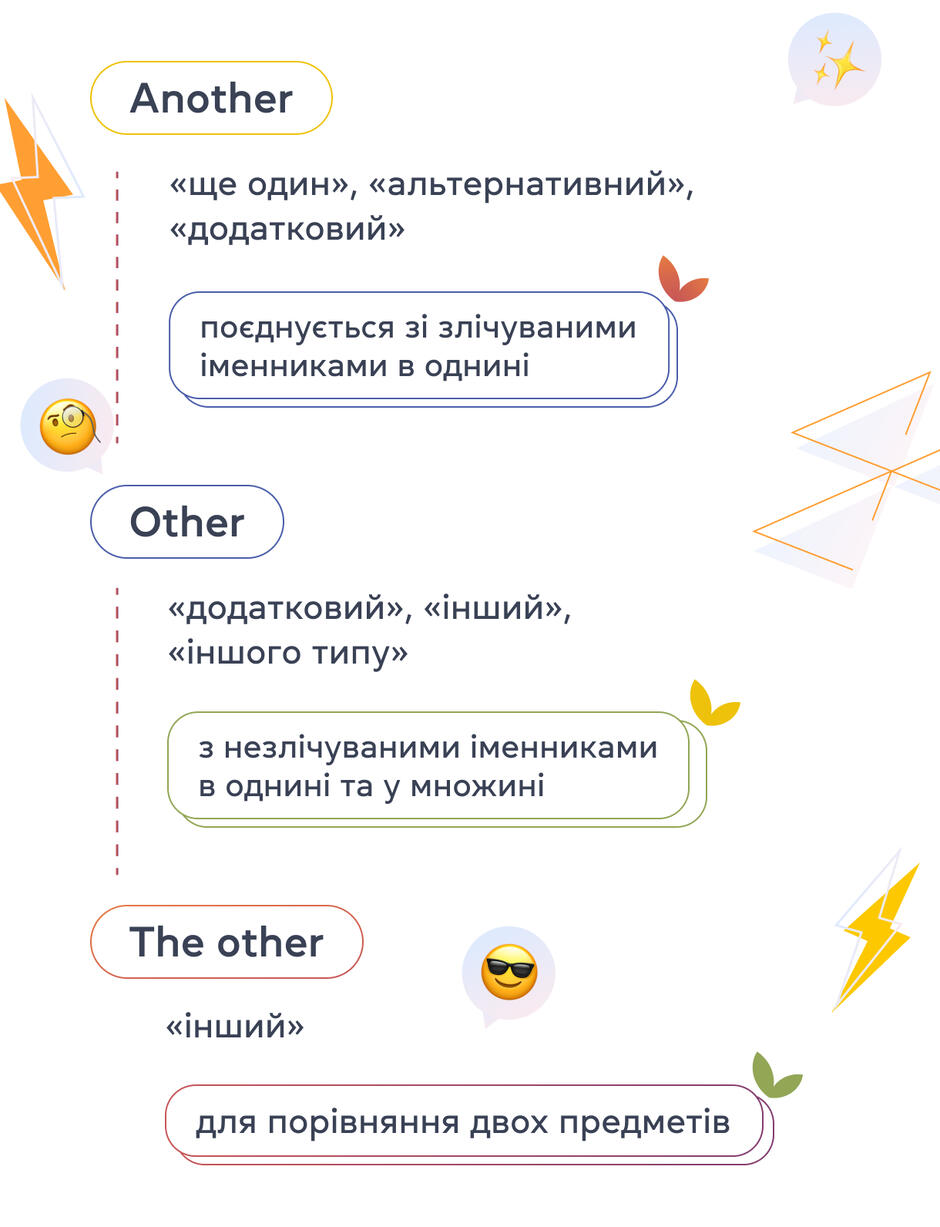
Another / other/ the other
Здавалося б, слова another, other і theother ідентичні. Ці три вирази, хоч і схожі за звучанням, однак тим, хто вивчає англійську мову, необхідно знати, чим вони відрізняються.
РОЗГЛЯНЕМО ПРИКЛАДИ РЕЧЕНЬ
This cafe is closed. There is another one over there - Це кафе закрите. Ось там є ще одне.
Can I have another piece of cake, please? — Можна мені ще один кусень торта, будь ласка?
I just finished one book, now I'm excited to start another— Я щойно закінчив одну книгу, тепер я з нетерпінням хочу почати іншу.
We wanted to see the palace and the castle, but my sister wanted to visit other places. - Ми хотіли побачити палац і замок , але моя сестра хотіла відвідати інші місця (тобто місця іншого типу)
2.Do ex. 1-2 p.147.
3.Ex.3,p.147,learn the rules.
Tuesday,the twenty-eighth of April.
Class work
1.New words.
monument — пам’ятник
motherland — батьківщина
square — площа
open-air — під відкритим небом
to find out — дізнаватися, з’ясувати
2.Do ex. 1-3 p.148-149.
3.Ex.4,p.149,learn the words.
Thursday,the thirteenth of April.
Class work
1.Do ex. 1-3 p.150.
2.Ex.4,p.150.
Friday,the first of May.
Class work
1.Do ex. 1-2 p.151.
2.Ex.3,p.151.
Tuesday,the fifth of May.
Class work
1.Do ex. 1-2 p.153-155.
2.Ex.3,p.155.
Thursay, the seventh of May.
Class work
1.Do ex. 1-4 p.156.
2.Ex.7,p.157,prepare for the test.
.
Friday, the eighth of May.
Test
1.Match
the countries to the names of the capitals.
1the
UK
a Kingston
2Ireland
b Suva
3The
USA
c Wellington
4Canada d
Dublin
5Australia e
London
6New
Zealand
f Ottawa
7Jamaica g Washington ,
D C
8Fidji
h Canberra
2.Choose the correct determiner.
1 Those/ That memorials are so amazing!
2 My suitcase is full. I need other/ another one.
3 A/The tickets you are holding are mine, not yours.
4 My cousins live in Belfast – their /our home town.
3.Grammar
Match
1 Both Michael …
a … because my family lives
there.
2 Neither Susan …
b … even if it rains.
3 Edinburgh …
c … and Tess are excited about this trip.
4 We will walk there …
d … before packing her things.
5 I want to visit Botswana … e … and Glasgow are in Scotland.
6 Sam always makes a list … f
…nor Ben want to go to Ottawa.
4.Describe a place of interest.
Tuesday,the twelfth of May.
Listening
Thursday,the fourteenth of May.
Speaking
I. Chose one of the topics below and make a talk about
1. Sports
Do you like sports? Why/why not?
How often do you exercise/play sports?
What sport/physical activity is popular in your
country?
What is your opinion on professional sports?
What do you think the top five most watched sports are
in the world?
What is the most dangerous sport?
What is the most expensive sport?
What is your favorite summer sport? What is your
favorite winter sport?
What new sports would you like to try?
Do you think everybody should practice sports?
Do you think playing sports helps people work better
as a team at work?
What do you do to keep fit?
What are some of the benefits of sports?
2. Healthy lifestyle
Do you think you have a healthy life style?
Is it possible to have a healthy life style in modern
world?
Why do many people try to have a healthy life
style?What is the main purpose of it?
What is healthy food?
Do you pay much attention to what you eat?
Do you think it is more important for you to eat
healthy or tasty food?
Do you try to eat your breakfast, lunch and dinner at
a certain time every day?
How many hours of sleep do you need daily?
If you don't sleep enough, how do you feel and look?
Do you try to go to bed and get up at certain hours
every day? What is good about it?
Do you often find yourself under stress?
How do you usually cope with stress?
Is there any connection between the person's style of
life and the duration of his life?
3. The UK
What is the difference between Great Britain, England
and the United Kingdom?
How do you think British people would describe their
country?
What do you know about British food and weather?
What would you like to do and see in the UK on a
three-week holiday?
Do you think Britain has too much political power in
the world?
Would you like to live in Great Britain?
4. Movies
What was the last movie you saw? How was it?
What is your favourite movie? Why?
How are the movies in your country? What are the
best ones?
How often do you watch movies in English?
If there were a movie about your life, what kind of
movie would it be? Why?
Which do you prefer, comedy movies or horror movies?
If someone were to make a movie about your life, what
would you
want included? Include AT LEAST three points !
Friday,the fifteenth of May.
Reading
Read the text and do the tasks
Sport is very important in our life. It is popular among young and old
people.
Many people do morning exercises, jog in the morning and train themselves
in clubs, in different sections and take part in sport competitions.
Other people like sports too, but they only watch sports games, listen to
sports news. They prefer reading interesting stories about sportsmen. But they
don't go in for sports.
Physical training is an important subject at school. Boys and girls play
volley-ball and basketball at the lessons. There is the sports ground near our
school and schoolchildren go in for sports in the open air.
A lot of different competition are held at schools, a great number of
pupils take part in them. All participants try to get good results and become
winners. Sport helps people to keep in good health. If you go in for sports you
have good health and don't catch cold.
There are some popular kinds of sports in our country: football, volley
ball, hockey, gymnastics, skiing, skating. Athletics is one of the most popular
kinds of sports. Everybody may choose the sport he (or she) is interested in.
My favourite sport is swimming. I go to the swimming-pool twice a week, but
I prefer to rest by the lake or the river and swim there.
True or False:
1.All
people jog in the morning and train themselves in clubs and sections.
2.Schoolchildren play games under the open air.
3.All
participants become winners in different
competitions.
4.Schoolchildren
have their favorite kinds of
sports.
5.The author of the text swims twice a week in the river.
Choose the right variant.
6.Many
people (take, do, go) sports.
7.Schoolchildren
go in for sports on the sports ground (indoors, at doors, outdoors).
8.(A lot of, Much, A few) pupils take part indifferent competitions.
9.Sport
helps people to keep (winners, fit, participants).
Choose the right
answer. More than one answer is possible:
10. If you go in for sports you can (get flu, be healthy,
catch cold, train in clubs)
11.A lot of people who don't go in for sports (read sports news, like sports, play games regularly).
12.Peoplechoose the sport they (hate, are interested
in, like, want to go in for).
Tuesday,the nineteenth of May.
Writing
I. Make up
the word-combinations.
1. to join a. in sport competitions
2. the Tower b. cathedral
3. to sing c. the Dnipro River
4. a magnificent d. of London
5. to participate e. a sports club
6. to cross f.in a choir
II. Complete
the sentences with the key-words: impressive,
street, cathedral, trip, a meeting,
museums, palace, London.
1. The main ……. of Kyiv,
Khreshchatyk, is not very long.
2. St. Andrew’s Church is an …….
building.
3. A lot of London’s …… and galleries
are free.
4. Queen Victoria lived in this
beautiful …… .
5. I dream about my …… to London.
6. Simon wanted to organize …… with
a famous writer.
III.Put the
verbs into the correct tense form.
1. My parents _____ (to watch) this
film yesterday.
2. Kate often _____ (to visit ) the
historical sights of Kyiv.
3. They _____ just _____ (to attend)
the English Club.
4. Tom _____ (to walk) on the beach
for 20 minutes.
IV.Put the
following sentences into negative and interrogative forms.
1. Many children visit the music
club in our school.





Немає коментарів:
Дописати коментар